
Without a people-centered AI strategy, companies risk losing their top talent
In May 2026, Gartner published the results of its Global Labor Market Survey, conducted in the first quarter of the year among more than 12,000 employees and managers in 40 countries. The key finding is clear: by 2027, 50% of companies without a people-centric AI strategy will lose their most skilled talent to competitors who have invested in empowering their workforce.
This fact shifts the focus of the debate: no longer “which tools to adopt,” but “how we are changing the way people work.”
Having access to tools doesn't mean knowing how to use them
One of the key concepts in the research is what Gartner calls the “enablement illusion”: the tendency of business leaders to confuse access to AI tools with actual transformation.
The numbers confirm this. 19% of employees surveyed say they haven’t saved any time with AI. Only 27% of C-level executives say they have a truly comprehensive AI strategy. And only 20% believe their workforce is truly ready to work with these tools.
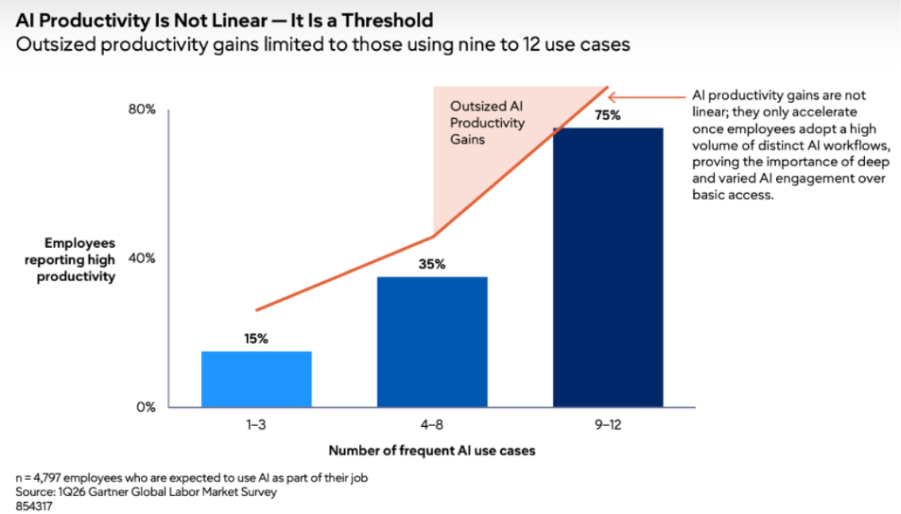
The key point is how many people use AI in a meaningful way across multiple use cases. Those who do are twice as productive, 2.3 times more likely to produce high-quality work, and 3.2 times more effective at improving processes.
73% of highly productive users are managers or executives. Workers who perform tasks that are most easily automated receive less support, less training, and less guidance on how to integrate AI into their daily work.
This creates a gap that is not just a matter of productivity: it is a problem of equity in adoption. The benefits tend to be concentrated where there are already resources and time to experiment, leaving behind those who work under operational pressure.
The adoption of AI is a cultural issue, not just a technical one
Perhaps the most significant finding: the fear of losing one's job to AI is slowing down widespread adoption, and standard technical training alone is not enough to counteract it.
"AI adoption is a cultural issue, not just a training issue";people's confidencein their future roles and the assurance that they will be supported rather than replaced is one of the strongest drivers of positive adoption. This goes hand in hand with transparent and ongoing communication about how AI will be used within the company.
The Gartner data reveals nothing unexpected for those involved in change management and AI adoption: technologies do not transform organizations on their own. It takes people who use them effectively, environments that support them, and a culture that embraces them.
What the data highlight is the urgency of the situation. Today, the key is not to lose the people who truly understand AI and who are currently weighing whether to stay with a company that trains and empowers them, or to move to a competitor that does. A people-centered AI strategy is not a nice-to-have but the minimum requirement for competing over the next two years.
How We Work at Digital Attitude
Guiding organizations through the adoption of AI while putting people at the center is at the heart of what we do at Digital Attitude. We don’t just implement tools—we start with concrete processes and use cases, focusing on cultural change, governance, and ongoing training. Because successful AI adoption begins with understanding how people work, what holds them back, and what empowers them.
If you're considering how to structure an AI strategy that generates real value for your organization, we'd be happy to discuss it with you.
[Source: Gartner]
.png)