
Cybersecurity: What It Means and How to Implement It in Your Company

Cyber threats are becoming increasingly complex and sophisticated. Securing your company means protecting it from data leaks, breaches, or other cybercrimes that can slow down or disrupt your business. But how can we defend ourselves?
First of all, let’s clarify a few things: by the term “cybersecurity,” we mean all measures aimed at securing computers, mobile devices, computer networks, software, applications, and data related to individuals, businesses, and institutions.
At first glance, it might seem that only large companies with high-tech IT infrastructures or big data stored in the cloud need to worry about cybersecurity, but in today’s hyper-connected world, a great deal of information is stored on our devices, and it is precisely our responsibility and habits of individuals that often determine a company’s actual level of cybersecurity.
Why is it important to discuss cybersecurity in the workplace?
Cybersecurity is now one of the greatest challenges of our time.
With the shift toward digital adoption and the ever-increasing spread of digital technologies in businesses, the risks associated with cybersecurity vulnerabilities have also risen. According to CLUSIT’s 2021 report (of which Digital Attitude is a member), the past year saw a record high in cyberattacks, with a 12% increase compared to the previous year—a trend that has been steadily rising over the past four years: 66% more attacks than in 2017.
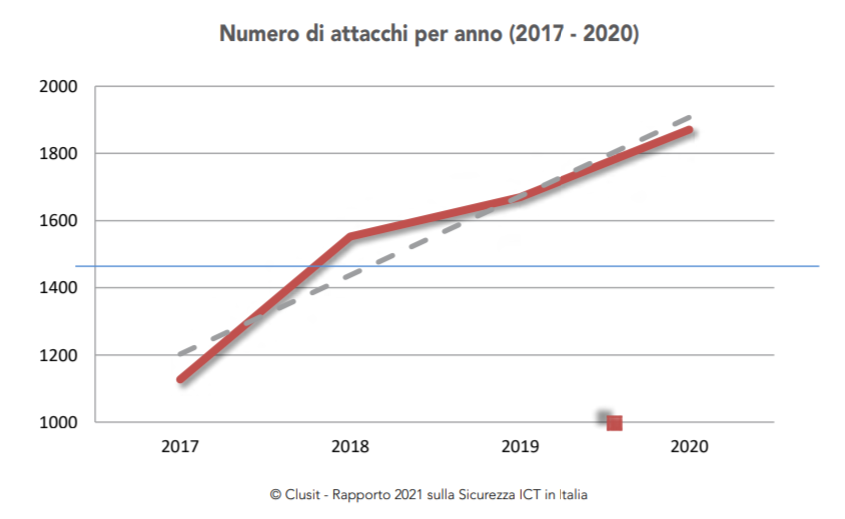
In addition, the Cybersecurity & Data Protection Observatory at the Politecnico di Milano also reported a 40% increase in cyberattacks in 2020. However, there is a silver lining: there has also been an increase in investment, particularly in endpoint security (protection of individual devices) and network & wireless security (protection of network infrastructure), a sign of growing interest from businesses in this field.
Still, it’s important to remember that taking corrective action after a cyberattack can be much more expensive than making an upfront investment in cybersecurity. In fact, leaders should view cybersecurity as an ongoing and systemic process, which naturally calls for a different approach to corporate investments in this area.
What are some of the main threats to cybersecurity?
Phishinginvolves deceptive emails that are specifically designed to appear as authentic as possible, mimicking reliable sources. The goal is to steal sensitive data or credit card information.
Malwareis a general term used to describe any software designed to steal information, damage a device, or encrypt data.
Ransomwareis a type of malware that blocks access to your device or certain files; to regain access, a ransom is demanded. The goal is to extort money.
Social engineeringis a highly sophisticated attack that involves studying employees with the aim of manipulating them to obtain information. This type of cyberattack does not exploit weaknesses in computer systems but rather exploits people and their psychological mechanisms.
How can cybersecurity (as both a process and a mindset) be implemented in a company?
First, it is necessary to conduct tests to identify any potential technical vulnerabilities using specific tools such as penetration testing.
Next, ad hoc policies should be developed at the strategic level, especially for sensitive operations, such as the use of two-factor authentication (2FA).
Nevertheless, when viewing cybersecurity as an ongoing process , it is essential above all to foster a culture and promote good habits among every single individual because, despite all technical security procedures, a great many cyberattacks are caused by people’s “bad habits, ” which unfortunately become the weak link in the corporate security system. In fact, CLUSIT reiterated in its 2019 report that:
“Mostsecurity incidents are linked to human error: the use of weak, non-alphanumeric passwords; connecting company devices to public networks; browsing unsafe websites; and transferring sensitive data via unencrypted USB drives(estimated to account for about 80%–90% of incidents)—confirming that the human factor is, even in cybersecurity, the weak link in the system. In Italy alone, it is estimated that approximately 53% of attacks are due to internal causes (…) and added to these are phishing and spear-phishing attacks, which have a significant impact on companies both in terms of fraud and stolen data and in terms of increased operational costs for recovery from incidents.”
Therefore, in addition to securing processes, networks, and tools, it is truly essential to focus on people and their habits. An innovative digital solution comes from hi | habit-inspiring platform, a digital coach capable of training every employee in the company to develop best practices and good habits, anticipating potential cyber threats and shifting the paradigm from ex-ante training to contextual, on-the-job training.
The specific characteristics and activities included in the coaching plan are carefully designed in collaboration with the company’s key cybersecurity personnel.
For more information and details, please contact us.
Cybersecurity: Frequently Asked Questions
What is cybersecurity?
By the term “cybersecurity,” we mean all activities aimed at securing computers, mobile devices, computer networks, software, applications, and data belonging to individuals, businesses, and institutions.
Why is cybersecurity important for businesses?
Over the past year, we have seen a record high number of cyberattacks, with a 12% increase compared to the previous year (CLUSIT 2021 data). These attacks did not target only certain sectors or specific technologically advanced companies. In today’s hyperconnected world, no company is truly “safe.”
What are the main types of cyberattacks?
The most common and major types of attacks are phishing and malware. Phishing involves deceptive emails designed to steal sensitive data or credit card information. Malware, on the other hand, refers to any software designed to steal information, damage a device, or encrypt data for the purpose of extorting money.

.png)