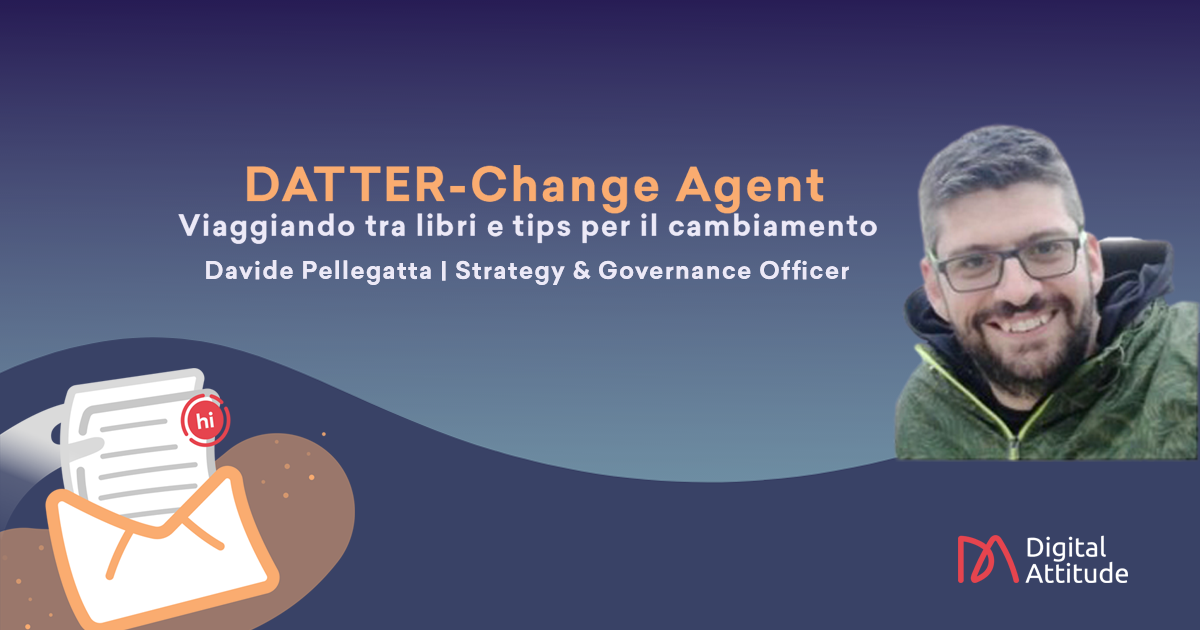
DATTER-Change Agent. A Journey Through Books and Tips for Change | Davide Pellegatta
The Journey of the “DATTERs.”
This is what I want to share in the second column I’m contributing to Digital Attitude. While in “Surfer People” I engage with those within companies who are riding the waves of organizational change, here I want to explore and share what lies within the dreams, studies, experiences, and—more generally—the “mindset” of those who—in this era marked by the “Great Resignation”—are investing themselves, working day and night, driven by a strong conviction.
I'll start with the name, which isn't obvious to me.
Dàt·ter, those who believe in Digital Attitude.
But that's not all: anyone who works to turn a shared dream into reality
Synonyms: Nerd, dreamer, explorer of new worlds.
People united by their focus on listening: to guide and embrace the true needs of those embarking on the extraordinary journey of change. People who believe that the best way to grow is through action and the ability to take care of ourselves, others, and the world around us.
People who know what it means to take on responsibility and love that feeling. That’s right, because the Datters have—and will always have—a startup mindset: speed, agility, initiative, and a willingness to take risks are at the heart of their approach to a changing world.
This brief description is what I read in their manifesto—which they give to anyone who joins the team—and it’s what convinced me that each of them had an interesting story to tell that could inspire us. So I decided to highlight their perspectives and experiences.
Next up, after Luca Argenton—CEO—today’s featured guest is Davide Pellegatta, Strategy & Governance Officer at Digital Attitude!
1) Hi Davide, I’ll start by asking you to take us back to your childhood: what job did you dream of having when you were little, and how does that connect to what you do today at Digital Attitude?
That’s a good one! When I was a kid, I dreamed of becoming a dad! And I have to tell you, I see the connection with my role at Digital Attitude: romantically and metaphorically speaking, I’m kind of the team’s dad, both because of my age and my seniority...After all, they pointed this out to me with my recent birthday gift: a jersey from the Italian championship-winning team (I won’t mention the name to avoid any sports-related conflicts while talking about work 😊) with “20+” (years in HR) printed on it.
2) Change: Can you recommend a book, a movie, and a song that will help us deal with it in the best way possible, explaining the reasoning behind each choice?
“…because everything changes over time, you know, and we change too, and we change too, and we change too, na na na…”.
My thesis begins like this, including “na na na”... With this quote, I’m sharing my passion for Vasco’s poetry, but this isn’t the right song for our answer. Instead, I’m choosing one that’s part of the playlist accompanying my talks on change management—specifically, the one that plays during the “end credits”: “Dal basso” by Jovanotti. There are essentially two reasons for this:
- the connection with the bass as an instrument, the rhythm of change; just as songs don’t stand on their own because of the solos (though, of course, people often remember them for those too), a change management program—in order to stand on its own—cannot consist solely of major communication or training events; it needs reinforcement, that daily “nudge”; it’s essential to keep up the rhythm of change;
- The second reason for this choice is hidden in the text (well, not too hidden, to be honest!); change is real only if it engages people, if it starts with them—from the bottom up, in fact...Change is found “where there’s energy, a sense of urgency, where there’s warmth…”; change is effective only when it shifts from expected behavior to actual behavior… by people, that is… #peoplehavethepower (to quote another song).
As for the book, I’ll choose a somewhat trendy one: *Start with Why* by Simon Sinek, which explores the topic of leadership—a crucial aspect of daily life and the foundation of any transformative journey! Too often, we plan things and propose initiatives without taking the time to explain the “whys” behind our actions or business decisions… On this point, I also agree with Saint-Exupéry: “If you want to build a boat, don’t gather men to chop wood, assign tasks, and give orders—instead, teach them to long for the sea.”
Finally, as for the movie, I suggest the same one I used to show during onboarding at the company and at my facilities: *Rocky*. Here, I focus on the risk we face when navigating change: losing our focus, our purpose, and our priorities.
In the final scene, Rocky—who managed to hold his own against the world champion—surrounded by the media, the audience, and all the people cheering him on, shouts his famous “Adrianaaaaa, Adrianaaaaa....Adrianaaaa,” revealing how, despite all the changes, his heart had remained the same. Change requires perseverance, determination, and a “tiger’s eye” on the long-term goal, just like the protagonist does 😊
3) Each of us has at least one project that is close to our hearts because it has led to significant and tangible professional growth. What was your first one?
This is complicated. I mean, the choice.
In fact, almost every work experience has helped me grow, and I hold it dear to my heart. I say this without hypocrisy or flattery. By nature, I tend to let myself be influenced by what I experience, and when something comes from within me, it’s even more overwhelming! I never throw anything away—by definition; I jealously guard everything, without any particular regrets—disappointments included, of course.
Going with my gut, my instinct right now is telling me to choose one: it was 2014, and among other things, I was also managing Internal Communications. We tried launching an Engagement for the first time (not just a workplace climate survey, but something more—one that also addressed issues of business alignment and processes) across the entire workforce, in all countries, and across all job roles, including manual workers. There was a lot of skepticism… but it actually went very well. From that project, one response in particular from a Bulgarian colleague has stayed with me—he was working on a construction site in Turkey and, in a post-survey interview, told me: “Davide, of course we were happy to respond: you were finally paying attention to us, listening to us, and involving us!” It made me reflect on the importance of conceiving and designing projects not only for those who work in the office—which, unfortunately, is a classic mistake—but also for field staff like him, and thus for the broader corporate ecosystem. In short, after receiving this feedback from that experience, I’ve had the opportunity to work extensively with this broader vision.
4) A mistake on a project that allowed you to improve your skills and/or products
I’m also pretty good at making excuses for my mistakes, and I’ve racked up quite a few. I’ve got a whole bunch of them, and even some duplicates… because the truth is, you don’t always really learn from your mistakes… or, at least, sometimes it takes two or three tries!
I’m thinking of a transformative project, where I realized that it’s not enough to just step up and take full responsibility—you also need to have the strength to protect the project itself and the team working on it. On one specific occasion, I realized that you must always anticipate and weigh the long-term impact on the team and that you need to take steps to mitigate that risk. Because otherwise, you’re not truly putting everyone at the center.
5) Given the experience you’ve gained over the years through your studies and working with various clients, could you share a short list of habits (no more than five) that can help bring about change?
1. Listen to and engage the people affected by the change
2. Take the time to engage with people “in person”—to pay attention to their moods and their expressions—because surveys are useful and important tools, but they aren’t enough on their own
3. Be patient: Change takes time (a lot of it) and happens “one nudge at a time”
4. Actively build the habit through recurring and planned actions, stimuli, and initiatives
5. Delivering on what you promise trumps everything else; marketing and big events aren’t enough; “walk the talk” mustn’t just be a catchy slogan.
6) To wrap up, here’s a disruptive question—just like everything Digital Attitude supports through change. Using an acrostic with your name—that is, using all the letters in your name—I’d like you to tell us about the company as you experience it.
Digital Attitude for:
I have six letters, and even a double one... My dad was right—I should have been named Sara... but that's another story :-D
Fun—the right word would be“messing around”—which, for me, is an essential part of my daily work routine and interpersonal relationships. You’ve got to have fun at the office, too; you can’t stay super focused and glued to your screens all the time—you end up losing productivity, precision, and energy.... You’ve got to recharge every now and then!
Listen, maybe it's just my HR DNA, but dedicating time to people is essential and non-negotiable for me. Tasks have their own deadlines, but people come first.
Truth—we often tell ourselves a few too many white lies—but I firmly believe that telling it like it is ultimately the winning strategy. If things aren’t going well, it’s not as if avoiding the issue or “telling ourselves a different story” solves anything; it simply puts it off, with the risk of dragging out not only the time but also the problem itself.
Learning—maybe it’s because I have two kids and so it’s a constant theme at home—but there’s no getting around it: you never stop learning… and for me, it’s also a conscious choice, something I truly enjoy! One of my key drivers has always been curiosity—discovering new things, understanding the world around me, cross-pollination, and dialogue—all as elements of self-discovery and growth, first and foremost as a person, and professionally right behind that.
Little Devil, especially within the Governance team (but not just there, mind you!); my role is primarily that of a “devil’s advocate”—or perhaps, better yet, a provocateur. Partly to unearth the truth I mentioned earlier and to push for consistency, vision, values, and people
Experience—well, this is kind of similar to what my dad said at the beginning. On DA, I try to share the years I’ve spent working at various companies, along with anecdotes, mistakes I’ve made, lessons I’ve learned, and everything that makes up the professional background of a “veteran” like me 😊
.png)