
Imagine walking into the office and discovering that dozens of new “colleagues” are working quietly: they’re answering emails, processing documents, analyzing data, and making decisions. They don’t have desks, but their impact on the organization is real and measurable. These are AI agents, and they’re radically transforming organizations and their workforces.
AI agents do more than just perform predefined tasks: they learn, adapt, and act with increasing autonomy. They are, in every sense, members of your new “digital workforce.” How does the role of the HR team change when part of the workforce consists of AI agents? How are processes being redefined? What strategies should be adopted to foster collaboration between people and AI agents?
The Double Standard of Governance: Control Over People, Autonomy for AI
When a company hires a new employee, the process is well-established: a user profile is created, specific credentials and permissions are assigned, training is provided, clear responsibilities are defined, and periodic evaluations are scheduled. There is complete traceability: we know who that person is, what they do, what resources they have access to, and who is responsible for their actions.
Now consider an AI agent created without a clear adoption process or plan: the agent can access sensitive data, make operational decisions, and interact with colleagues—perhaps even sharing confidential information. Yet, in most organizations, “DIY” agents operate in a gray area: unclear ownership, permissions assigned without precise criteria, and no periodic review of their performance. It’s a surprising paradox: we apply rigorous standards to people, yet we allow AI agents to operate without a structured management framework.
Gartner’s research paints a clear and imminent picture. By 2027, more than 80% of digital workplace management tools will incorporate artificial intelligence capabilities. Even more significant: by 2029, more than half of organizations will adopt autonomous management systems for corporate devices, compared to virtually none in 2025.
This proliferation brings with it extraordinary opportunities for efficiency and innovation, but also significant risks. Companies that fail to prepare for what is known as “agent sprawl”—that is, the uncontrolled proliferation of AI agents—will find themselves exposed to security vulnerabilities, hidden costs, and a loss of control over their business processes.
The Phenomenon of Agent Sprawl
Agent sprawl is the new shadow IT. Just as departments used to create their own technology solutions without the knowledge of central IT, teams and individuals today are implementing AI agents without coordination or oversight.
The result? A chaotic ecosystem of agents that:
- Duplicate functionality: different teams create similar agents without realizing that equivalent solutions already exist;
- They create compliance issues: agents that connect to critical systems without documentation;
- Maintain access after termination: flows and connections that continue to operate even after the primary agent has been removed;
- They introduce vulnerabilities: excessive permissions or unauthorized third-party connectors that create security holes
The solution? An HR framework for AI agents
Visibility: The Organizational Chart of Agents
The first step is to know who (or what) is working for you. Just as an HR system keeps a complete record of all employees, organizations need a comprehensive inventory of all active AI agents.
This inventory must answer fundamental questions: we need to know how many there are and in which environments they are located (Microsoft 365 or third-party solutions), as well as who owns them and who is responsible for their creation, maintenance, and behavior. It is essential to know the data and systems they access, the permissions they have, and who uses them—whether they are users or other systems. Finally, it is helpful to track their history: when they were created, when they were updated, and when they were last used.
Without this visibility, there can be no accountability. A modern governance system should provide a searchable, filterable, and exportable dashboard of all agents, linking them to their owners and the systems with which they interact.
Agent Lifecycle Management: From Onboarding to Offboarding
Just as Human Resources manages employees from hiring through termination, AI agents require structured management throughout their entire lifecycle.
Onboarding: Controlled Onboarding
Before an agent becomes fully operational, it must undergo a rigorous approval process, especially if it accesses sensitive data, critical systems, or uses external APIs. The process includes: verifying the need, assessing risks, obtaining consent from data owners, conducting a security review, and assigning a responsible party.
Change Management
Agents evolve: new permissions, additions, or changes to the logic require re-approval, just like a change in an employee's role.
Offboarding: Complete Termination
When an agent is no longer needed, it must be deactivated and safely removed: delete data flows and connections, revoke credentials, archive documentation, and update the inventory.
All too often, this process is incomplete, leaving "ghost agents" that continue to run in the background, consuming resources and posing potential vulnerabilities.
Performance Evaluation: “Performance Reviews” for AI Agents
Just as employees receive periodic evaluations, AI agents should undergo regular reviews based on concrete metrics.
- Risk Scoring: Not all agents pose the same level of risk. To assess this, one must consider the sensitivity of the data they access, the scope of their permissions, the connected systems, the use of external APIs, and their level of decision-making autonomy. An agent with a high risk score requires more frequent monitoring and, in some cases, additional restrictions.
- Usage Monitoring: Just like an employee, an agent that doesn’t add value is an unnecessary cost. Monitoring usage is essential: how often it is activated, whether it generates useful results, whether it has recurring errors, and whether users actually find it useful. Underutilized agents should be evaluated for decommissioning, while the most active ones may require optimization or scaling.
- Cost Tracking: With pay-as-you-go models, costs can rise quickly. You need visibility into monthly costs, trends over time, and ROI: Does the value generated justify the cost? Only then can you make informed decisions about which agents to keep, optimize, or eliminate.
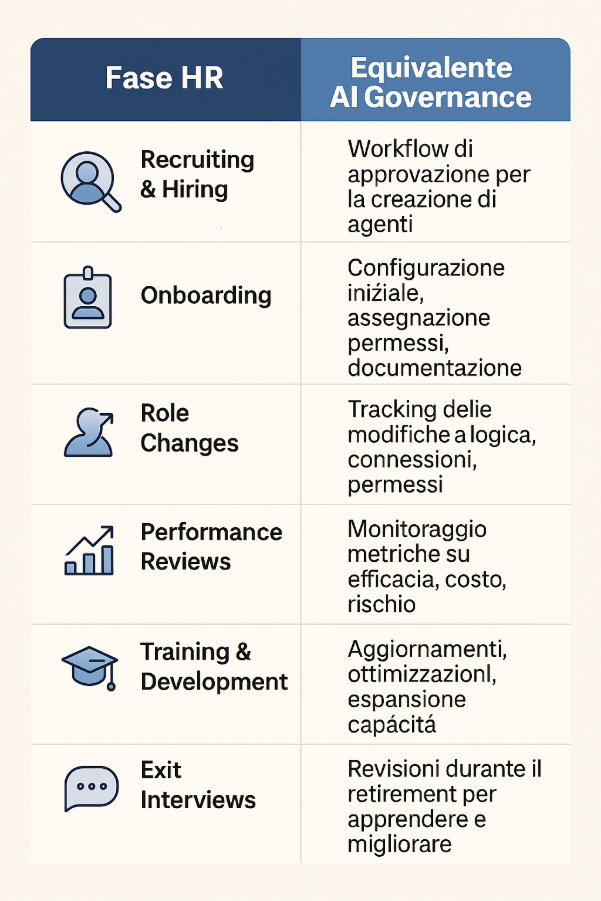
Managing AI agents as true digital employees is not just an effective metaphor—it represents agenuine paradigm shift in the way organizations operate. It means recognizing that these agents are not mere tools, but operational entities with a real and tangible impact on the customer experience, the efficiency of internal processes, data security, overall costs, and even compliance risk.
But defining policies isn’t enough: concrete processes are needed to ensure that what’s written down is actually put into practice. This means introducing automated workflows, standardized checklists and templates, and well-defined roles and responsibilities, along with metrics and KPIs that allow for measuring effectiveness and operational impact.
Toward Digital Workforce Management
You would never run a business without knowing who your employees are, what they have access to, and who is responsible for their actions. The same logic now applies to AI agents. The key difference is that the number of “digital employees” can grow much more rapidly.
So talking about AI agent governance doesn’t mean slowing down innovation. On the contrary: it’s about enabling responsible scaling. Organizations with robust governance frameworks can adopt AI faster and with greater confidence, because they know they have visibility and control within their processes.
We must act now—before agent sprawl becomes unmanageable or before a security incident exposes the organization. Agents must be governed in the same way that people are managed—that is, with systems, processes, and transparency.
Governance of AI agents is therefore a strategic necessity. But we know it can seem like a complex undertaking: where do we start? Which processes should we implement first? How do we balance control and innovation?
Digital Attitude helps organizations design and implement effective and sustainable AI processes. Contact us for a consultation.

.png)