
How to Manage and Organize Your Time: 5 Tips and Some Help from Technology

“Time is money!” Or perhaps, is our time worth more than money? Or maybe we’ve truly realized that “We Are Time”?
Time is an irreplaceable and fundamental asset, as it is a scarce resource that we absolutely cannot regenerate: we can always have more financial resources, but we cannot have more time at our disposal. For this reason, we must increase our own awareness—and that of our team—about what is truly worth investing our time in. This approach is the first step toward helping us change our habits and become more productive.
Time management techniques can help with this , as they allow us to better organize our workday and increase productivity (while keeping work-life balance in mind). In fact, improving our efficiency at work not only allows us to achieve results more quickly but also gives us the freedom to devote more time to our personal lives, our families, or our passions. Additional benefits include reduced procrastination, stress, and anxiety.
But how can we put the principle of time management into practice in our organization? Here are 5 tips that are useful for everyone, especially for those who aspire to be good digital leaders.
5 Tips for Managing Your Time More Effectively
Planning The best way to avoid wasting your time is to plan your tasks, activities, and meetings in advance. By planning each workday, you’ll know what your main goal is for that day.
Author and time management expert Brian Tracy states that “Every minute you spend on planning saves 10 minutes in execution; this gives you a 1,000 percent return on energy.”
- Priorities - The Eisenhower Matrix
We must not only plan ahead for everything we need to accomplish but also organize it by priority. This way, we can identify the most urgent tasks: missed deadlines will be nothing more than a bad memory!
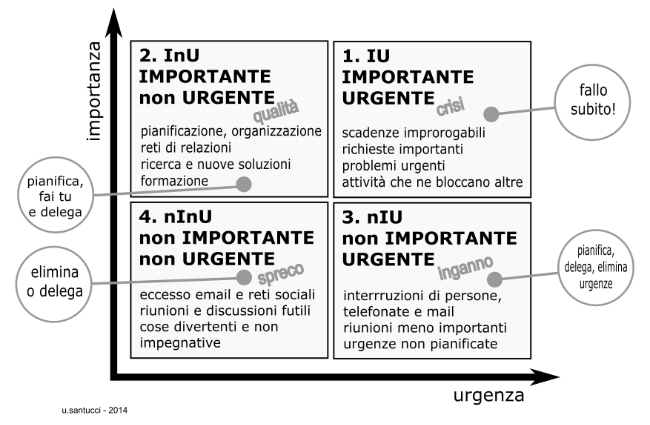
In this regard, the Eisenhower Matrix method can be useful, as it allows you to manage and organize long to-do lists more effectively; each task is placed in one of the squares of the matrix based on criteria of importance and urgency:
1 – Crisis: important and urgent (actions that cannot be delegated and must be completed as soon as possible)
2 – Quality: important but not urgent (actions to be planned for a later time)
3 – Deception: Urgent but not important (actions to be delegated)
4 – Waste: neither important nor urgent (unnecessary actions)
- Keep an eye on Parkinson’s Law
Cryril Northcote Parkinson stated that“Work expands to fill the time available; the more time there is, the more important and demanding the work seems.”
This means that if a person has afullweek to complete a task, they will use the entire week to carry it out. In fact, the pressure of a deadline drives us to finish our work more quickly. For this reason, time blocking can be helpful—that is, setting aside a specific block of time in your calendar to complete a particular activity.
- Ask your colleagues and your team for support
Sometimes the best thing to do is to discuss matters with your team and the people around you, so that you can better define goals, deadlines, and priorities. Discussing things with others not only allows us to divide up the work but also strengthens the soft skills of the entire group by improving cohesion, collaboration, and trust among team members.
- Let technology help you
Technologycan help with time management. There are several apps that let you keep track of your activities, enter your commitments into a digital calendar, schedule meetings, and take collaboration to the next level.
Digital Support for Your Team
If you're looking for a digital solution that will help boost your team's productivity, optimize time management, and improve your work-life balance: hi | habit-inspiring platform is the right solution for you!
Thanks to coaching plans focused on remote well-being and effective meetings, improving time management and productivity will be a breeze. hi trains everyone in your organization with contextual tips and nudges, leaving no one behind.

.png)