

Everyone, at some point in their learning journey, has experienced—at least once—the feeling of an unbridgeable gap between theoretical concepts and daily practice—that is, the challenge of turning what they’ve learned into concrete actions and changing their habits. What if it were possible to bring these two aspects together and learn right in the moment while performing an action?
What is learning by doing?
This process is called “learning by doing.” It is a form of experiential learning that allows individuals to acquire theoretical concepts by applying them directly in their field of practice, thereby significantly accelerating change. Furthermore, we can also refer to this as contextual learning, which focuses on steadily expanding one’s knowledge (step by step) within the context of one’s daily work.
Learning by doing and contextual learning are two sides of the same coin; in fact, both go beyond so-called traditional training, which is characterized primarily by intensive hours of lecture-based instruction, often not sustained over time.
In today’s context, this naturally raises the question: since business strategies are now all based on customer centricity, shouldn’t learning be as well? Shouldn’t we place more focus on the learner? Learning by doing and contextual learning emphasize the importance of the learner, placing their learning—and the people involved—at the center, rather than mere concepts.
David A. Kolb and Experiential Learning
It was the scholar David A. Kolb who introduced the concept of experiential learning into the literature, defined as a process in which knowledge is created through the transformation of experience. This process consists of four stages:
- Stage of concrete experience; personal interpretation of an experience;
- Stage of reflective observation, understanding through observation and active listening;
- The stage of abstract conceptualization, analysis, and organization of information;
- The stage of active experimentation: learning as a result of action.
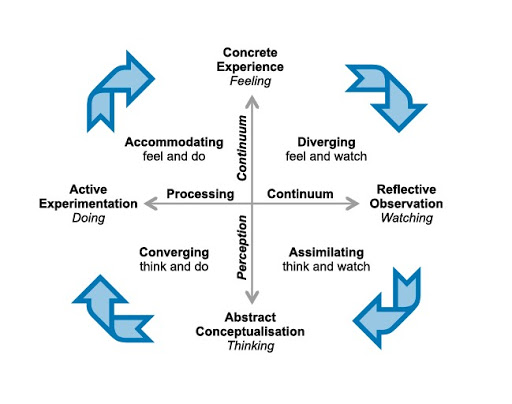
Furthermore, David A. Kolb’s theory identifies four learning styles: convergent, adaptive, divergent, and assimilative. Since we do not all learn in the same way, it is essential to understand that learning must be personalized.
The trainer must be a coach capable of adapting to the learning needs of individuals, facilitating the contextual aspect of learning from a process-oriented perspective: because learning is a journey—it is not merely about acquiring facts, but about developing new experiences and habits, that is, actions repeated over time.
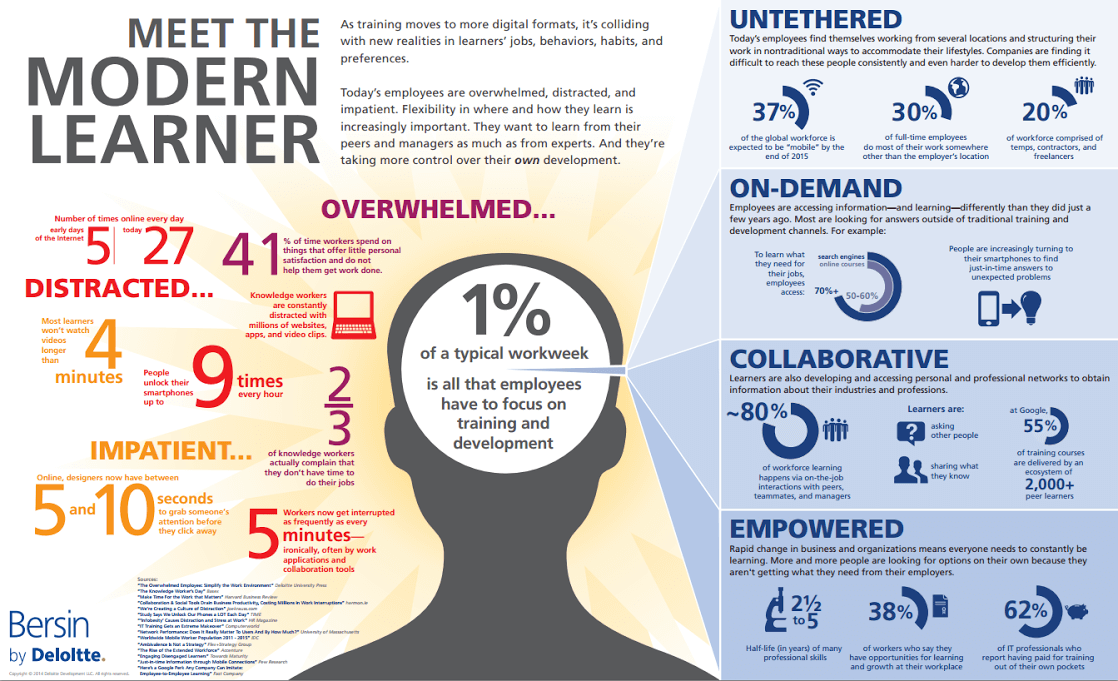
A Digital Solution for Contextual Learning
The digital coach hi | habit-inspiring platform places these principles at the heart of its approach to corporate training. Thanks to scientific research and machine learning algorithms , hi offers users contextual (right while they’re working) and personalized learning.
In addition, hi trains its users through small daily steps, allowing users to independently explore topics in greater depth as they wish. All of this is always accompanied by a sense of journey, because, as we’ve mentioned before, learning is a process, and hi accompanies all users through every stage of this journey.
.png)