Are we the same people who started working from home in early 2020? Does the world of work still seem the same to us?
If the answer is no, then we are left to ask ourselves: What is the role of the physical office today , and how can we build an engaged team in a digital-first world? What impact do mindset and corporate culture have on the New Ways of Working? The challenge for organizations is to meet the new expectations of their people while striving to deliver business results in an increasingly unpredictable economy.
To answer these questions, Microsoft, in its annual Work Trend Index report, conducted a survey of 31,000 people (including Italian workers), which revealed some very interesting trends. Let’s take a closer look at them:
Employees have a new set of values
People, Places, and Process: these are the cornerstones for navigating the ever-changing landscape of the New Ways of Working. However, especially today, it is essential to address the deeper “Why” that drives people to choose a particular job. In fact, following the past two years, employees have a new perspective on what they want from work and what they are willing to sacrifice for it. Indeed, data from Microsoft shows that 54% of Italians are more likely to prioritize their health and well-being
This trend is in line with data on the “Great Resignation” —that is, all the people who decided to leave their jobs over the past year: in Italy, that figure stands at 17%, or one in five. Finally, younger workers in particular—Gen Z and Millennials—are considering changing employers; 49% are doing so, compared to 46% of young talent in 2021.
“Work is only a part of life. It shouldn’t be your whole life or the only thing you care about.”
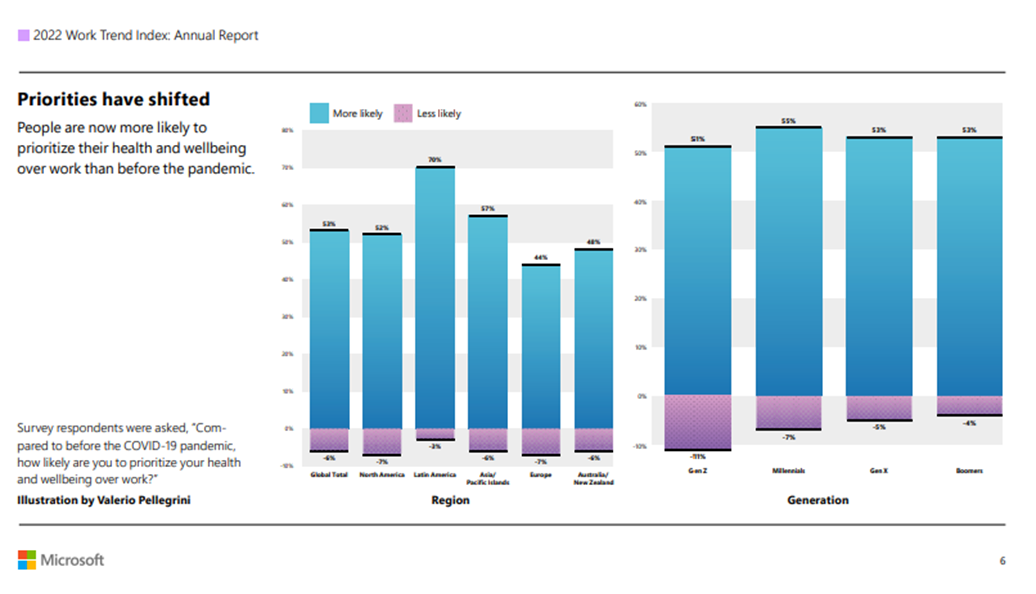
The best leaders will be those capable of changing the company’s mindset, culture, and values by prioritizing the well-being of their employees, viewing all of this as a genuine competitive advantage for building sustainable growth.
Managers are struggling to "keep up" with the demands of leadership and employee expectations
Managers serve as the link between leadership and employees’ aspirations; however, especially over the past two years, many managers have felt truly overwhelmed in this regard: in fact, 74% say they lack the influence or resources to bring about real change.
For example, in Italy, despite the undeniable desire for flexibility and hybrid work evident in the data on Italian employees, 47% of Italian executives say their company plans a full-time return to the office in 2022. This polarization is then reflected in management: in fact, 56% say that company leadership is not aligned with employees’ expectations. It is therefore important to give managers greater autonomy so they can manage their teams in the best possible way.
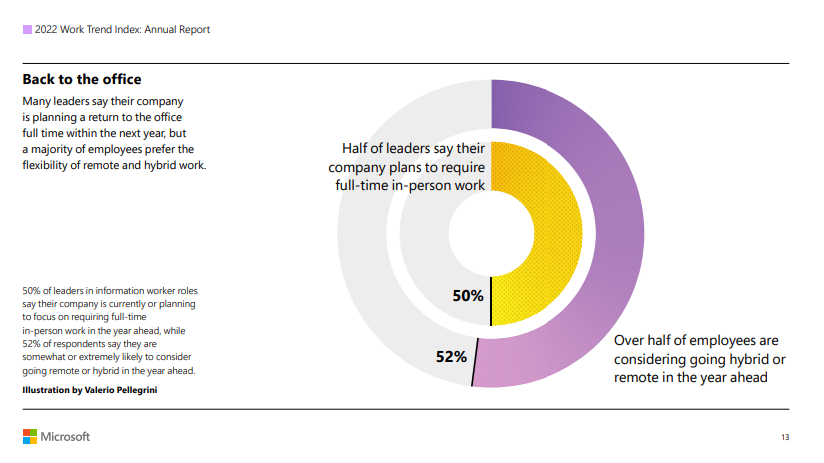
The office as a motivating space—one worth commuting to
Now that we have experienced the benefits of remote work, we need to reimagine the role of the office, and the challenge for leaders is to motivate employees to return to the office as well, by finding new sources of motivation and opportunities. In fact, in Italy, 33% of hybrid employees find it difficult to understand when and why they should work in person at the office. However, despite this situation, only 27% of Italian executives have established new company policies for hybrid work.
The shift toward hybrid work and hybrid meetings obviously brings with it a change in mindset and culture as well, aimed at creating shared experiences that make everyone feel engaged and included, beyond mere hardware and software considerations.
The data suggests that companies are making progress in space and technology, but there is still so much work to be done on culture
“You must design workplaces with enough flexibility to support every employee. A mix of quiet spaces, collaboration areas, and touchdown locations helps ensure that everyone can stay connected, engaged, and productive.”
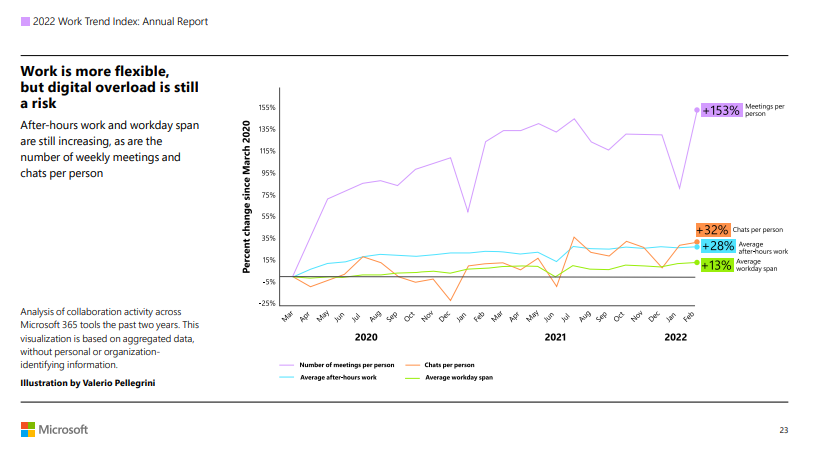
Flexible work, yes; always on call, no
M365 productivity data shows that the global weekly average of time spent in meetings on Teams has increased by 252% since March 2020, and work outside regular business hours and on weekends has increased by 28% and 14%, respectively.
We must therefore pay increasing attention to what is known as “digital overload”: flexible and hybrid work must be sustainable and take place within certain limits.
Rebuilding Social Capital in a Hybrid World
One of the areas most affected by remote work is undoubtedly its impact on relationships. As was the case last year, this year’s Work Trend Index data confirms that 54% of Italian “hybrid” workers feel a greater sense of loneliness in the workplace compared to the pre-pandemic period. Not surprisingly, according to 49% of executives surveyed in Italy, the main challenge of the hybrid work era will be the ability to engage employees in social activities and build a genuine sense of corporate community.
Therefore, a potential return to in-person interactions should not merely be a way to rebuild social capital; rather, leaders should prioritize situations and initiatives that allow us to build or rebuild the human relationships we have lost over the past two years.
“Empowering people to do their best work is not only in their best interest—it’s good for business. To make hybrid work successful, leaders need to empower managers to be the guardians of the company culture, rethink the role of the office, rebuild social capital for a digital-first workforce, and create new practices for sustainable flexible work. Technology plays a key role, but this moment calls for a new mindset.”
You can find Microsoft's full research here
.png)