Onboarding is one of the most significant and important steps in the process that kicks off a person’s experience at a new company. It is precisely here—in those first impressions and interactions between the company and the individual—that the exchange of feelings and emotions begins, contributing to the development of the mindset needed to best build mutual trust, engagement, and familiarity with the activities, people, places, and contexts that will then shape their daily work life.
In fact, it involves introducing the new hire to their first colleagues—their faces and stories—familiarizing them with the company’s policies and values, and, of course, supporting them in their initial tasks and activities. However, onboarding is also an opportunity for the company to present itself in the best possible light, with a strong focus on innovation today. Handling this phase effectively not only allows the new hire to build collaborative relationships right from the start and move beyond the traditional paradigm—which is tied to the time and place where interactions occur and behaviors are learned—but also, by getting a head start on the onboarding process, helps reduce future turnover rates, which, in the era of the Great Resignation, is a challenge that is more relevant than ever.
In fact, according to research on this specific topic, 69% of employees are less likely to leave the company if they initially had a positive onboarding experience. The challenge today is to ensure that this remains the case even in a digital-first environment, adapting it to the complexities of the New Ways of Working.
How, then, can we move beyond the Cartesian plane—where space and time intersect in different ways when a person joins a company? How can technology help us design a new employee experience that takes all of this into account and engages new hires in innovative ways—and perhaps even helps foster new attitudes and mindsets?
Digital Technology for Onboarding
At Digital Attitude, we put ourselves to the test by first envisioning and then designing a new user experience for the most significant and pivotal moments of the onboarding process, ultimately mapping out innovative pathways thanks to the hi | habit-inspiring platform.
This is a digital coach and mentor that can serve as a useful tool for creating an onboarding process that values people while also strengthening employee branding, by fully leveraging the potential offered by technology and artificial intelligence.
By actively listening to people’s needs and using a co-design approach, we were able to create a specific onboarding journey to guide new employees through the typical stages, as outlined below:
1. Clarification: knowledge of the business context;
2. Culture: an in-depth look at the organization’s values and purpose;
3. Compliance: approaches and tools to facilitate daily work;
4. Connection: How to Realize Your Potential Through Lifelong Learning.
The journey in hi's coaching plan
Here, we’ll share some key pillars and typical features of using habit-inspiring platforms specifically in the onboarding process. For any further details—including those tailored to each company’s specific context—we’d be happy to schedule a meeting with anyone interested in seeing how these platforms are applied in practice.
With hi installed on your work device, you can begin your “journey” by receiving daily tips—short text messages that appear on the screen—allowing for the exchange of all necessary information between the company and the employee. This fosters circular communication and continuous engagement, thanks to the various calls to action included in the messages. The tips are linked to in-depth content (learning materials) based on the principle of micro-learning. With an on-demand model, these materials can be explored at different times, leading to training and learning paths tailored to your own schedule: just 3 minutes a day is all it takes to follow the prompts and advance along the path.
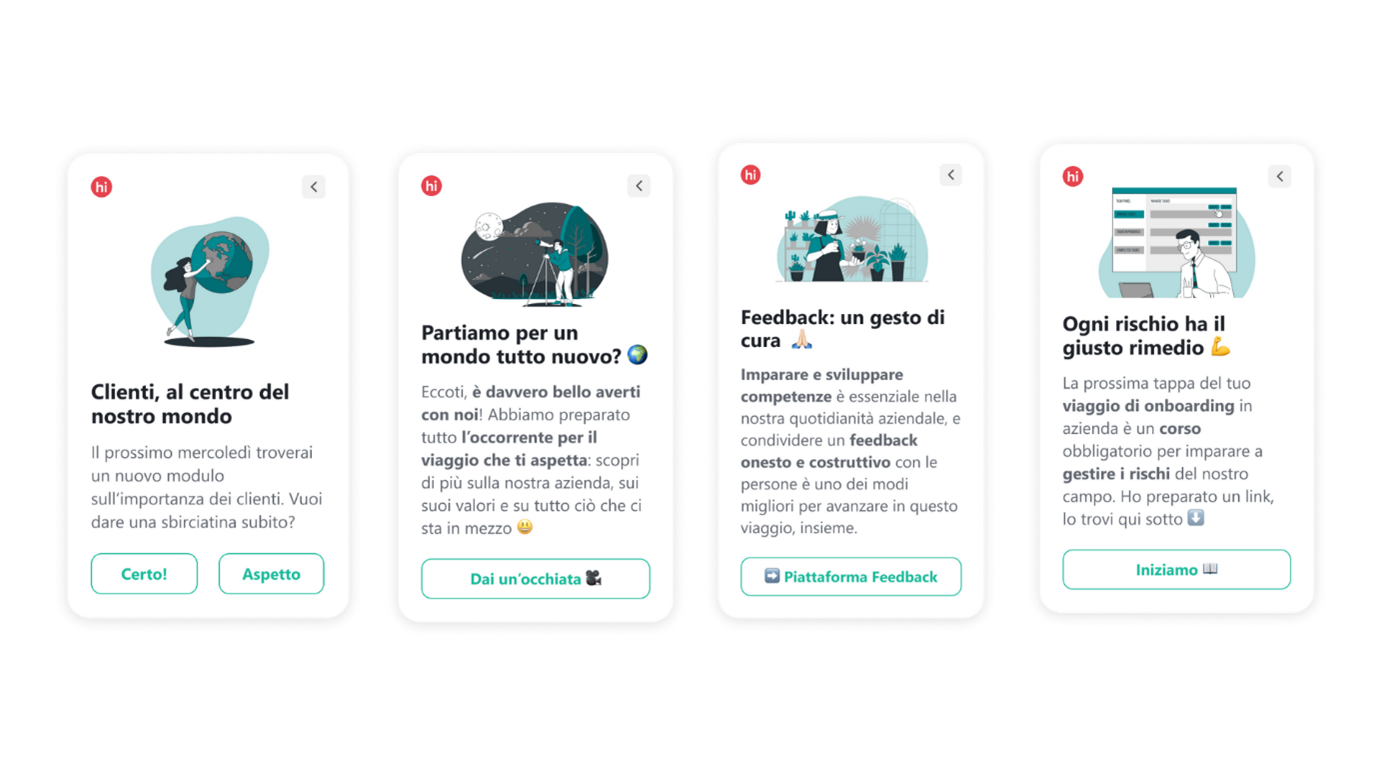
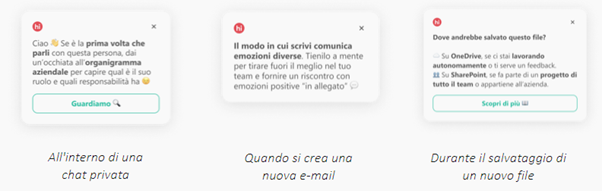
What is the best way to learn—especially in this era when the blurring of work locations and schedules requires harmony with the flow of individual work—if not through learning by doing and on the job? It is precisely on this principle that nudges (the second component of “hi” in the journey) are based; by leveraging behavioral patterns and behavioral design, they suggest actions and behaviors to put into practice to achieve learning goals, reinforcing good habits in one’s daily work. Nudges are suggestions and guidelines that are perfectly aligned with an individual’s workflow, contextualized and personalized based on their interests, needs, and the specific skills being developed, all orchestrated through an approach that integrates and harmonizes with other content, platforms, or materials already present within the corporate landscape.
Finally, the analytics technology underlying the habit-inspiring platform allows us to track metrics or KPIs to be achieved in order to effectively measure performance. This will enable us to make data-driven decisions and clearly understand which onboarding actions have been effective and which ones require further reinforcement of the concepts learned through additional insights, by collecting both qualitative and quantitative feedback.
On this journey, the use of a digital coach makes it possible to guide each person through their onboarding process, much like a personal trainer within the company. This makes the process increasingly engaging, sustainable, automated, and personalized for each individual.
If you'd like to learn more about the materials, how the platform works, and what journeys and experiences can be created, please contact us: book your one-on-one session here
.png)