Just Talking About Well-Being, or Actually Addressing It? A Conversation with Giada Susca

We need a new relationship between people and the company. This is what seems to be emerging most strongly in recent times. It’s also the response I received in a recent survey I published on LinkedIn®:
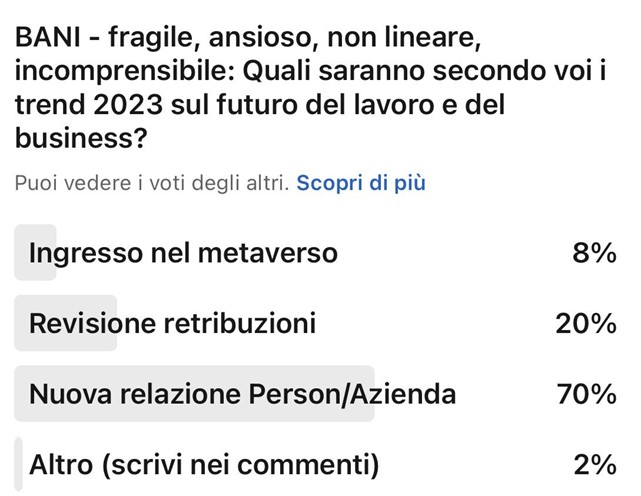
Many have questioned the “old rules” and are seeking new career paths; many others have already changed jobs, and most of those who have done so were motivated by the desire for greater well-being.
The word “well-being” has perhaps never resonated as deeply as it has since the pandemic called our health into question and upended all our habits, breaking down the long-established barriers between work and life in many professions—to the point where we can hardly use the word “balance” anymore, as it is increasingly being replaced by “integration” in the “best” cases.
From the initial nonstop work to the loss of all certainty, many HR professionals—those responsible for people within organizations—immediately began to prioritize well-being as a key focus to promote internally to retain employees and externally to attract new talent. Yet, in reality, concrete actions haven’t always followed through—so much so that a video is circulating online that ironically pokes fun at the limited approach of offering only simple webinars on the topic, which, relying solely on theory, fail to address real needs.
If people want to take better care of themselves, they are—and will certainly continue to be—increasingly drawn to organizations that promote well-being initiatives aligned with these new needs. So, as I pondered what this new relationship between people and companies should look like, I tried to discuss it with Giada Susca about this topic.
First, I’d like to introduce her to those who don’t know her—as part of our strong professional partnership, through which we’ve been working together on various projects for years:

Giada, what is organizational well-being, and why is it emerging as a priority in organizations?
GS: “An organization’s ability to promote and maintain the physical, psychological, and social well-being of all its employees is defined as organizational well-being. Studies and research on organizations have shown that the most efficient organizations are those with satisfied employees and a harmonious and participatory ‘internal climate.’ Motivation, collaboration, engagement, the proper flow of information, flexibility, and trust among employees are all factors that lead to improved mental and physical health among workers, greater user satisfaction, and, ultimately, increased productivity” [Source: Ministry of Education, Ministry of Universities and Research]
The WHO (1998) defines health as “a state of complete physical, mental, and social well-being, not merely the absence of disease or infirmity”; organizational health is “the set of cultural and operational approaches, processes, and organizational practices that foster harmonious coexistence in work settings through communication and collaboration, promoting, maintaining, and improving the physical, psychological, and social well-being of work communities.” Organizational health and well-being can therefore be defined not only as the absence of illness but as a state of harmonious functional, physical, psychological, and relational balance in the individual, who is dynamically integrated and in relationship with his or her natural and social environment. [Source: OGGI PA]
I think it’s appropriate to start with some authoritative definitions of organizational well-being to help us clarify a concept that has implications for every aspect of a person’s life. The pandemic has inevitably marked a turning point regarding this issue; let’s be honest, before the COVID-19 era, the well-being of people within organizations was not a priority. It was unthinkable to talk about fear, emotions, stress, or fatigue. Today, that is no longer the case. Addressing well-being is no longer just a nice-to-have but a must in the “New Now,” and to do so effectively and authentically—recognizing this as an opportunity for everyone—it is essential to familiarize ourselves with these issues and develop new skills.
A recent McKinsey report reveals that the factors negatively affecting employees’ well-being from an organizational perspective include the feeling of always having to be available, being subjected to unsustainable workloads, having little autonomy, and a lack of social support; but above all, the factor that seems to contribute most to the onset of burnout (a state of emotional, physical, and mental exhaustion, classified by the WHO as a form of work-related exhaustion) is a toxic organizational environment.
But the good news is that those who work in human resources—and those in managerial and organizational roles—can use expertise in wellbeing as a key resource for the care, development, growth, and well-being of their teams.
Today , it is no longer possible to say , “That doesn’t concern me ,” and proclaim that “the person is at the center” without addressing the mind, body, and emotional sphere. We must therefore “train” ourselves to live and work better, retain and attract talent, embrace constant change, navigate critical moments, and find ways to give new meaning to our work: and this, perhaps, is the greatest challenge of our time.
Our personal and professional lives are not separate worlds, and the pandemic has shown us exactly that.
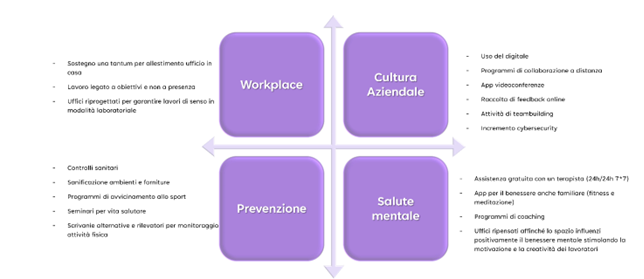
Many organizations have therefore begun to invest valuable resources in well-being, considering it a top priority—also to support productivity. But we are still in the early stages of a journey toward true cultural transformation; the image below summarizes the major initiatives that have been implemented in the areas of the workplace, corporate culture, prevention, and mental health.
Numerous studies show that in order to approach the development of a key competency such as well-being in a healthy way, it is necessary to rethink the meaning of work—not on an individual basis, but through a systemic approach at all levels. The skills of active listening and tailoring are absolutely the foremost allies in fostering mindful behaviors that promote and sustain a culture of well-being—ensuring it does not become just another “passing fad, ” but rather enables the creation of lasting achievements that are harbingers of meaningful growth.
Collaboration, a shared sense of purpose, and collective commitment are what can truly make a difference.
Where should you start when it comes to well-being?
GS: I was referring to the importance of listening, which is absolutely the foundation on which to build. It is essential to meet with people individually to gather information that will allow us to design programs that are not based on a top-down approach.
The next step is sharing, and here, internal communication plays a central role, as it is tasked with promoting the importance of mental and physical well-being and guiding employees through a process that supports specific organizational decisions.
A third aspect is managerial: no action can be meaningful if the behavior of those tasked with leading workgroups is not aligned with what is being promoted and is not the result of a shared process at multiple levels. This is where the importance of training to develop new managerial skills comes into play; as mentioned earlier, these skills are no longer just a “nice-to-have,” but are essential to supporting a change that involves transforming deeply ingrained and often toxic habits.
To achieve this, it is simply impossible to imagine solving everything with informational webinars or one-time meetings. Well-being means change, and for changes to take root, they require a long period of time—during which reflection, experimentation, and concrete implementation with regular check-ins can truly make a difference.
Last but not least, the role of HR, which will need to orchestrate a genuine process of change management and employee experience, so that we can move beyond the concept of “people-centered” and transition toward “the people-centered experience.” Yes, because every situation deserves attention and a listening ear; every action must be guided by its impact and its ability to reconnect us to the meaning of what we do—allowing us to trust the organization and bring energy and enthusiasm into the workplace, as we grapple with the real-world problems that are no longer confined to the outside of our office doors. But above all, because caring for people is a tremendous responsibility that we often—very often—forget.
Finally, I’d like to ask you to daydream a little. You know that Digital Attitude creates “gentle nudges” through technology, so I’d like to ask you: What is the nudge that, in terms of well-being, should be promoted the most?
GS: I believe it’s essential to focus on experiences and the data they can yield. As a gentle nudge, I therefore propose reimagined workspaces—beautiful, stimulating, immersive, and organized around people’s interests and needs. I’d like to observe the behaviors and choices of those who inhabit these workspaces and understand how people cluster. For example, I envision corners where people can reflect on psychological safety, and others where they’re inspired by art, music, poetry, and so on. In this way, I’d make these spaces accessible and open and observe what people choose; I see this as a deeper understanding of people’s needs, upon which we can build and design tailored well-being programs.

.png)