

The year 2024 marks a significant turning point in the use of artificial intelligence in the workplace. Who hasn’t tried asking ChatGPT to write a sentence or Midjourney to generate an image? Who hasn’t used a chatbot on a website or tried Gemini for a web search? This is the reality for many of us. In fact, according to the annual “2024 Work Trend Index” report by Microsoft and LinkedIn, the use of generative AI has doubled in the last six months, with 75% of knowledge workers globally using it.
Faced with an ever-increasing workload and a constant stream of communication, employees are independently seeking out the AI solutions they find most useful for their work—as if to say, “If the company won’t provide them, I’ll take care of it myself.” This practice, known as“Bring Your Own AI” (BYOAI), involves introducing personal AI tools into the workplace without seeking authorization or support from one’s company.
This phenomenon also highlights a gap between individual adoption and corporate strategy, with leaders recognizing the importance of AI but often lacking a clear vision for its large-scale implementation.
In fact, according to Microsoft, 67% of the workers surveyed said they use at least one personal AI solution in their work, and 43% said they prefer BYOAI over corporate solutions. This bottom-up adoption is a response to the pain points that AI addresses, particularly managing mass communication and heavy workloads. As a result, users who are using AI tools report that they have saved time (90%), been able to focus on what matters most at work (85%), and enjoyed greater creativity (84%).
Today we are pleased to interview Luca Argenton, CEO of Digital Attitude, who will talk to us about the challenges and opportunities associated with adopting the “Bring Your Own AI” model within organizations.
1. The "2024 Work Trend Index" report highlights that 75% of knowledge workers already use AI tools, often without company approval. What are the main benefits and risks you see in the adoption of AI tools that are not officially approved by companies?
The"2024 Work Trend Index" report confirms the growing importance of AI in the workplace. The experiments many of us have conducted with generative AI tools such as ChatGPT and Midjourney are increasingly moving from the personal to the professional sphere.
However, the report also highlights the other side of the coin: many companies are not yet ready to effectively manage this transformation or keep up with the pace their employees would like.
The BYOAI phenomenon illustrates this contradiction perfectly. On the one hand, people have discovered firsthand how AI can tangibly improve productivity and stimulate creativity. This demonstrates that the use of AI tools delivers tangible value—a sign that companies cannot ignore and from which it is difficult to turn back.
On the other hand, the adoption of unapproved AI tools entails risks that are often underestimated or ignored by workers, such as the loss of control over data, the risk of privacy breaches, and the lack of quality and ethical standards.
To avoid these scenarios, it is essential that companies develop a clear and shared AI strategy.
2. The report mentions a certain reluctance on the part of business leaders to implement AI due to pressure to demonstrate an immediate return on investment. How should C-level executives address this challenge?
To address the challenge of artificial intelligence, a tactical response dictated by the latest trend is not enough. Executives must adopt a strategic—and, above all, systemic—vision. Simply measuring return on investment in monetary terms is no longer sufficient. AI is not just a technological challenge, but also a shift in mindset and behavior.
That’s why we’re not just talking about ROI (Return on Investment), but also ROE (Return on Experience): tracking how and to what extent AI improves and enhances people’s experiences is the key to success.
To embrace a transformation of this magnitude, we must move beyond a monolithic view and adopt a holistic approach, in which technology interacts with corporate culture. In this context, elements that may seem contradictory must find a constantly evolving balance.
Establishing a multi-stakeholder governance team is essential for success. Only by doing so can companies fully harness the potential of AI, ensuring its safe and effective adoption in a way that meets the needs of both the business and its employees.
3. Many employees fear that the introduction of AI could render their roles obsolete. For this reason, they are reluctant to ask for corporate AI tools and instead use personal AI tools “on the sly.” How can the proper adoption of AI also help reduce anxiety about new technologies?
This is an aspect we care deeply about and are constantly exploring, using a tool we developed called Emotional Radar.
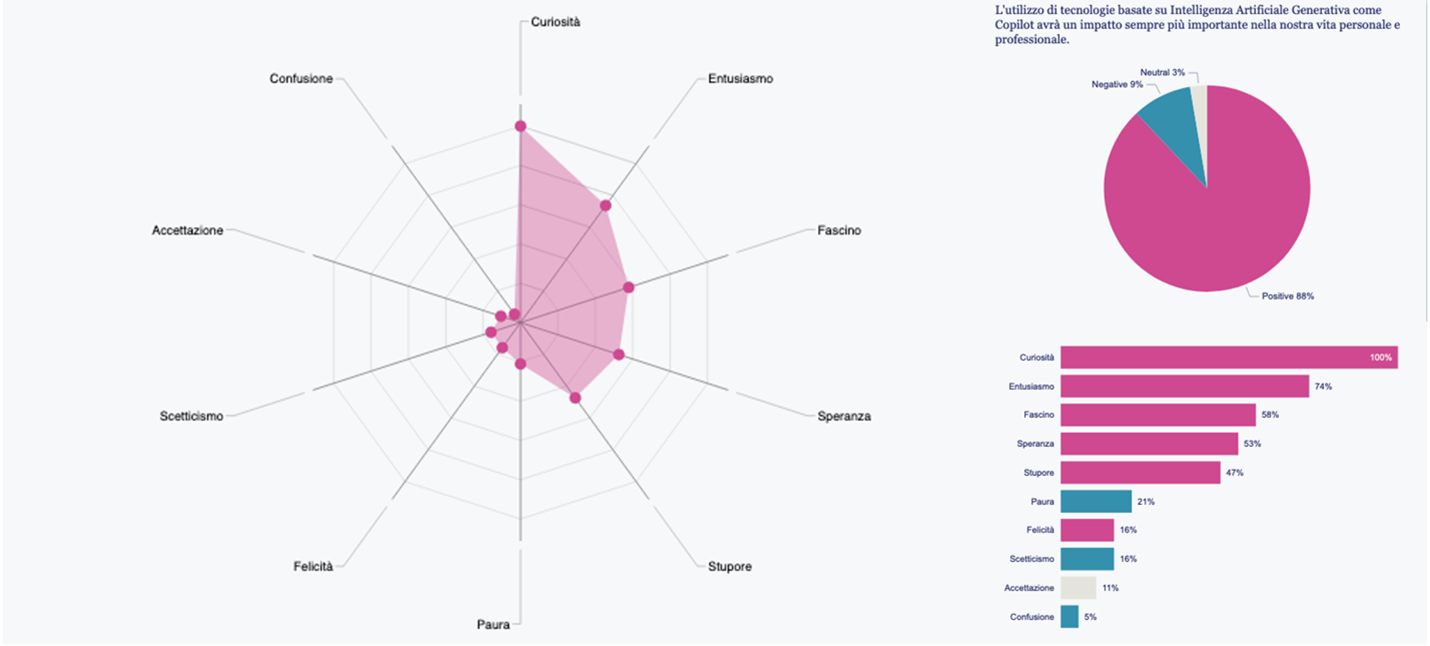
As can be seen from the graph, on the one hand, people say they are fascinated, intrigued, and excited to experience the potential of AI firsthand. On the other hand, they express feelings of concern, skepticism, or confusion.
Understanding these emotional responses is essential for guiding the process of introducing and adopting AI.
To do this, it’s not enough to just talk about technology; we must help people rediscover the skills that underpin a thoughtful and sustainable adoption of technology: the ability to ask powerful questions, to frame them effectively, and to analyze the results critically, while remaining mindful of potential biases or illusions.
4. The report indicates that only 39% of employees worldwide have received AI training from their company. What initiatives is Digital Attitude implementing to bridge this skills gap?
At Digital Attitude, we have developed and implemented various AI adoption programs. We are among the first companies in Italy to support Italian businesses in their M365 Copilot journey, using an approach that brings people and technology together.
The latest project we've completed helps you develop a holistic understanding of what AI is and what impacts it can have—all while having fun!
It’s called “AI Game” and is an innovative card game designed for workgroups and corporate teams. It transforms learning about AI into a collaborative, stimulating, and team-building experience. The game lasts 120 minutes, during which participants create a thematic map, then discuss and draw logical connections during a debriefing session. AI Game aims to educate and engage people of all ages and backgrounds on the potential and implications of artificial intelligence. Through an interactive, playful, and fun approach, it promotes a deep and informed understanding of AI, encouraging the responsible development and use of these technologies.
Thank you to Luca Argenton for sharing his insights with us on how the “Bring Your Own AI” phenomenon is influencing the world of work and how companies can navigate this new technological landscape dominated by artificial intelligence.
Want to learn more about AI Game and how to bring it to your company? Click here

.png)